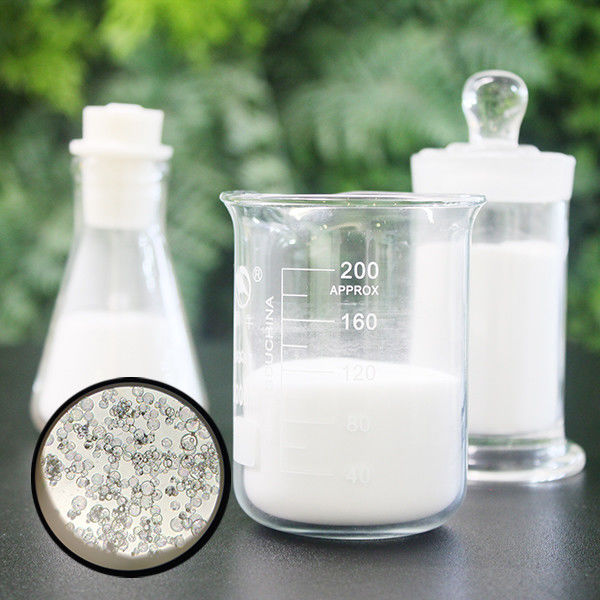
Descripción del producto:
Las microesferas de vidrio son partículas esféricas avanzadas ampliamente utilizadas en diversas aplicaciones industriales y científicas debido a sus propiedades físicas y químicas únicas. Estas diminutas esferas poseen un espesor de pared que varía de 1 a 2 micras, lo que contribuye significativamente a su ligereza y resistencia. Su forma esférica garantiza uniformidad y consistencia, lo que las convierte en una opción ideal para mejorar el rendimiento de materiales compuestos, recubrimientos y otras formulaciones.
Una de las características más notables de las microesferas de vidrio es su excelente resistencia química. Exhiben buena resistencia a la mayoría de los productos químicos, lo que les permite mantener su integridad estructural y rendimiento incluso cuando se exponen a entornos hostiles. Esta resiliencia química hace que las microesferas de vidrio sean particularmente adecuadas para aplicaciones en la industria química, donde los materiales a menudo se someten a sustancias agresivas.
La conductividad térmica es un factor crítico en muchas aplicaciones que implican regulación o aislamiento de temperatura. Las microesferas de vidrio tienen un bajo valor de conductividad térmica de aproximadamente 0.2, lo que significa que actúan como aislantes térmicos eficaces. Esta propiedad ayuda a reducir la transferencia de calor, lo que hace que estas microesferas sean muy beneficiosas en productos de aislamiento térmico y componentes estructurales ligeros donde el control de la temperatura es esencial.
Además de sus propiedades funcionales, las microesferas de vidrio están disponibles en colores blanco o blanquecino. Esta coloración neutra les permite mezclarse a la perfección en diversas mezclas y formulaciones sin alterar significativamente la apariencia del producto final. Ya sea que se utilicen en pinturas, adhesivos o compuestos poliméricos, su compatibilidad de color aumenta su versatilidad.
El espesor de la pared de las microesferas de vidrio, que típicamente varía entre 1 y 2 micras, es un aspecto crucial de su diseño. Esta estructura de pared delgada pero duradera proporciona un equilibrio perfecto entre resistencia y ligereza. Las paredes delgadas aseguran que las microesferas aporten un peso mínimo al compuesto general, al tiempo que ofrecen suficiente resistencia mecánica para reforzar los materiales.
Debido a su forma esférica y distribución precisa del tamaño, las microesferas de vidrio pueden mejorar las propiedades de flujo de líquidos y pastas, mejorar la suavidad de los recubrimientos y proporcionar un mejor control sobre la densidad y el volumen en las formulaciones. Su capacidad para reducir el peso de los compuestos sin comprometer la resistencia o la durabilidad las convierte en un componente indispensable en las industrias aeroespacial, automotriz, marina y de la construcción.
Además, el uso de microesferas de vidrio puede generar ahorros en los procesos de fabricación. Al reemplazar rellenos más pesados con estas microsferas ligeras, los fabricantes pueden reducir los costos de materiales asociados con el envío y la manipulación. Adicionalmente, la incorporación de microesferas puede mejorar la eficiencia general y el rendimiento de los productos, contribuyendo a una vida útil más larga y una mejor experiencia del usuario.
En resumen, las microesferas de vidrio son partículas esféricas y ligeras con espesores de pared de 1-2 micras, que ofrecen buena resistencia química y baja conductividad térmica de 0.2. Disponibles en blanco o blanquecino, proporcionan excelentes beneficios funcionales y estéticos en una amplia gama de aplicaciones. Su combinación única de propiedades asegura que sigan siendo una opción preferida para las industrias que buscan optimizar el rendimiento de los materiales manteniendo la rentabilidad y la durabilidad.
Características:
-
Nombre del producto: Microesferas de vidrio
-
Densidad aparente: 0.15-0.3 G/cm³
-
Forma: Esférica
-
Composición química: SiO2, Na2O, CaO, MgO, Al2O3
-
Resistencia a la compresión: Hasta 100 MPa
-
Conductividad térmica: 0.2
-
Ideal para aplicaciones que requieren un relleno ligero con 1 atributos de alto rendimiento
-
Ofrece 1 excelente equilibrio entre resistencia y aislamiento térmico
-
Contiene 2 componentes químicos clave para una mayor durabilidad y estabilidad
Parámetros técnicos:
|
Densidad aparente
|
0.15-0.3 G/cm³
|
|
Resistencia a la temperatura
|
Hasta 600°C
|
|
Conductividad térmica
|
0.2
|
|
Resistencia a la compresión
|
Hasta 100 MPa
|
|
Resistencia química
|
Buena resistencia a la mayoría de los productos químicos
|
|
Forma
|
Esférica
|
|
Color
|
Blanco o blanquecino
|
|
Densidad real
|
0.58-0.62
|
|
Composición química
|
SiO2, Na2O, CaO, MgO, Al2O3
|
|
Aplicaciones
|
Rellenos ligeros, aislamiento, compuestos, espumas sintácticas
|
Aplicaciones:
Las microesferas de vidrio, caracterizadas por su forma esférica y un diámetro que varía de 20 a 75 µm, son materiales muy versátiles ampliamente utilizados en diversas aplicaciones industriales y comerciales. Su composición química única, que consiste principalmente en SiO2, Na2O, CaO, MgO y Al2O3, les confiere una excelente durabilidad y estabilidad química, lo que las hace ideales para escenarios que exigen materiales de relleno ligeros pero resistentes. Con una densidad real de solo 0.58 a 0.62, estas microesferas reducen significativamente el peso total de los materiales compuestos sin comprometer la integridad estructural, lo cual es crucial en industrias como la aeroespacial, automotriz y la ingeniería marina.
Una de las ocasiones de aplicación destacadas para las microesferas de vidrio es en la fabricación de materiales compuestos ligeros. Debido a su baja densidad y forma esférica, mejoran las propiedades mecánicas y el aislamiento térmico de los compuestos poliméricos. Estos compuestos se utilizan a menudo en la producción de componentes de aeronaves, piezas de automóviles y cascos de barcos, donde la reducción de peso se correlaciona directamente con una mejor eficiencia de combustible y rendimiento. Adicionalmente, su resistencia a temperaturas de hasta 600 °C asegura que mantengan la estabilidad y funcionalidad incluso en condiciones de alto calor comúnmente encontradas durante los procesos de fabricación o entornos operativos.
En el ámbito de los recubrimientos y selladores, las microesferas de vidrio actúan como rellenos eficaces que mejoran la textura, la durabilidad y las propiedades de aislamiento térmico de pinturas y adhesivos. Su capacidad para soportar estrés térmico de hasta 600 °C las hace adecuadas para recubrimientos protectores aplicados en entornos industriales, como hornos y tuberías, donde las altas temperaturas son prevalentes. Además, la morfología esférica ayuda a lograr capas lisas y uniformes que mejoran el acabado superficial y reducen el consumo de material.
La industria del petróleo y el gas también se beneficia de la aplicación de microesferas de vidrio, particularmente en fluidos de perforación y operaciones de cementación. Su baja densidad y resistencia química contribuyen a reducir el peso total de los lodos de perforación, mejorando las características de flujo y reduciendo el desgaste del equipo de perforación. Además, en las formulaciones de cemento, estas microesferas actúan como agregados ligeros que mejoran el aislamiento térmico y reducen la contracción, aumentando así la vida útil y la fiabilidad de la cementación del pozo.
Otro escenario notable es en el campo de la electrónica y el aislamiento eléctrico. Las microesferas de vidrio se incorporan en materiales aislantes para proporcionar una estabilidad térmica y resistencia eléctrica superiores. Su capacidad para mantener la integridad a temperaturas tan altas como 600 °C asegura un rendimiento fiable en aplicaciones electrónicas exigentes, como placas de circuito y resinas aislantes.
En general, las ocasiones y escenarios de aplicación para las microesferas de vidrio son diversos y se expanden continuamente. Su combinación única de forma esférica, baja densidad real (0.58-0.62), composición química (SiO2, Na2O, CaO, MgO, Al2O3) y resistencia a la temperatura hasta 600 °C las hace indispensables en industrias que buscan materiales ligeros, duraderos y térmicamente estables. Ya sea en compuestos aeroespaciales, recubrimientos de alto rendimiento, perforación de petróleo y gas o aislamiento electrónico, las microesferas de vidrio proporcionan consistentemente soluciones innovadoras a complejos desafíos de ingeniería.
Preguntas frecuentes:
P1: ¿Para qué se utilizan las microesferas de vidrio?
R1: Las microesferas de vidrio son esferas huecas y ligeras comúnmente utilizadas como rellenos en materiales compuestos, adhesivos, recubrimientos y espumas sintácticas para reducir la densidad y mejorar las propiedades de aislamiento.
P2: ¿Cuál es el rango de tamaño típico de las microesferas de vidrio?
R2: El tamaño de partícula típico de las microesferas de vidrio varía de 10 a 100 micras, lo que permite una dispersión uniforme en diversos materiales de matriz.
P3: ¿Son las microesferas de vidrio químicamente resistentes?
R3: Sí, las microesferas de vidrio exhiben una excelente resistencia química a la mayoría de los disolventes, ácidos y álcalis, lo que las hace adecuadas para su uso en entornos químicos hostiles.
P4: ¿Cómo afectan las microesferas de vidrio a las propiedades mecánicas de los compuestos?
R4: La incorporación de microesferas de vidrio en compuestos puede reducir el peso total y mejorar el aislamiento térmico, al tiempo que mantiene una resistencia y rigidez adecuadas según la aplicación.
P5: ¿Qué precauciones se deben tomar al manipular microesferas de vidrio?
R5: Al manipular microesferas de vidrio, utilice equipo de protección personal adecuado, como mascarillas y guantes, para evitar la inhalación y el contacto con la piel, y trabaje en un área bien ventilada.


 ¡Su mensaje debe tener entre 20 y 3.000 caracteres!